Fluid Bed Dryer vs. Spray Dryer
This article compares fluid bed dryers and spray dryers by feed form, mechanism, and the type of product each one produces. It also covers where a vibrating fluid bed dryer fits in when a standard fluid bed dryer can't handle certain materials.
What Actually Separates These Two Drying Methods
The real difference between a fluid bed dryer and a spray dryer starts with the feed itself. A spray dryer takes liquids or slurries and turns them into dry particles in one step, atomizing materials into a fine mist and flash-drying the droplets in hot air. A fluid bed dryer starts with materials that are already wet solids — granules, crystals, or a wet cake — and dries them by suspending those existing particles in an upward flow of hot air.
Choosing between the two methods usually comes down to one question: does your process need to create particles from liquids, or does it need to dry particles that already exist?
How a Spray Dryer Turns Liquid Into Powder
A spray dryer force-feeds liquids through a nozzle or rotary atomizer, separating liquids into fine droplets inside a large drying chamber. Hot air contacts each droplet, and because the droplets are so small, moisture flashes off in seconds rather than minutes. The result is a fine, roughly spherical powder whose particle size is set largely by the atomizer, not by a separate sizing step.
How a Fluid Bed Dryer Dries Existing Particles
A fluid bed dryer works on materials that are already particulate: upward airflow suspends wet solids so hot air reaches the full surface area, and drying continues until materials reach a targeted moisture content (see our article on the working principle for how this fluidization actually happens). Because the feed is already solid, the fluid bed dryer's job is limited to removing moisture, not shaping the particles in the first place.
| Fluid Bed Dryer | Spray Dryer | |
|---|---|---|
| Feed form | Wet solids: granules, crystals, wet cakes | Liquid or slurry |
| Particle formation | Not performed; dries existing particles | Performed during atomization |
| Typical residence time | Minutes to hours | Seconds |
| Common industries | Battery materials, specialty chemicals, granulated pharmaceuticals | Food and dairy powders, detergents, pharmaceutical solutions |
Where Each Method Fits Best
Spray drying fits processes that start with solutions or slurries and need powders as the end product: dairy and food powders, detergents, ceramic precursors, and pharmaceutical formulations dried directly from solutions. Fluid bed drying fits processes where materials have already been formed into particles or wet cakes, often after a filtration, centrifugation, or granulation step — common in battery materials, specialty chemicals, and granulated pharmaceutical products.
Materials that arrive as liquids usually need a spray dryer regardless of downstream requirements, since a conventional fluid bed dryer without a spray system cannot atomize liquid feeds.
Product Quality and Process Considerations
Spray dryers' very short residence time can protect heat-sensitive liquids from prolonged exposure, but the atomizer and drying tower represent a larger, more specialized capital investment than most fluid bed installations. Fluid bed dryers take longer per batch but give operators more control over final moisture content and particle integrity, since the materials are already formed and simply need their moisture content reduced without being reshaped in the process.
When a Vibrating Fluid Bed Dryer Extends the Choice
Some wet cakes and granulated materials sit in a gray area: they are technically solid enough for fluid bed drying, but too sticky or unevenly sized for a standard fluid bed to fluidize reliably. Rather than switching to spray drying — which would mean redesigning the process around a liquid feed — adding vibration to the fluid bed can be enough to fluidize these borderline materials without changing the fundamental process.
Electronics Manufacturing
- Barium titanate
- Silicon carbide
- Alumina
(VH Type)CHUO KAKOHKI (JPN)

(https://www.chuokakohki.co.jp/dryer.html)
- Ideal for Purity-critical materials like SiC. Sliding-part-free design prevents contamination, while vacuum drying protects against thermal degradation.
- Precision developed through more than 200 drying tests each year*1 delivers uniform drying while preserving material properties, contributing to high-quality semiconductor production and improved productivity.
Fuel Production
- Coal
- Aggregates and industrial sand
- Wood chips

(https://carriervibrating.com/equipment/dryers/)
- Unique electronic control automatically adjusts to different drying times based on the type and condition of minerals and sand.
- Vibration intensity and feed speed adjust according to moisture content and viscosity, helping reduce variation in moisture content.
Food Manufacturing
- Granulated food powders
- Active pharmaceutical ingredients
- Plant-based protein
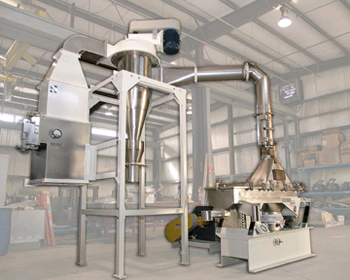
(https://www.witte.com/new-food-grade-process-equipment-integrates-drying-classifying-and-fines-collection-in-a-single-sanitary-sound-attenuated-pilot-sized-unit/)
- Most structural materials are made of stainless steel. Hygienic design that meets USDA, FDA, and 3-A standards*2.
- Tool-free disassembly enables easy cleaning and inspection across drying, cooling, and classification sections—supporting efficient maintenance and contamination prevention.
*1 from official Website (https://www.v-dryer.jp/dryingtest.html)
*2 Related to contact with food and dairy products.