What is a Fluid Bed Dryer? Definition, Working Principles, and Industrial Applications
This article explains the definition, working principles, and applications of fluid bed dryers.
What Is a Fluid Bed Dryer?
It is an industrial device that dries materials such as powders and particles by blowing air through them. By applying hot air from below, the materials are lifted and dried as they become fluidized. Because the materials are exposed to air evenly, uneven drying is minimized.
Understanding How Fluidization Works Visually
Fluidization is a phenomenon in which air is introduced upward from below into a layer of powders or particles, lifting the particles and causing them to move like a liquid. The airflow causes the particles to become suspended and dispersed, allowing the entire bed to circulate gently. Because each particle comes into uniform contact with the air, heat and moisture transfer occur efficiently. This is why fluid bed dryers can deliver efficient, uniform drying.
Industrial Applications of Fluid Bed Dryers
Because fluid bed dryers can dry materials uniformly in a short time, they are used in the following industries.
- Chemical (resin raw materials, inorganic powders, catalysts, and pigments)
- Pharmaceutical (active pharmaceutical ingredients, granulated powders, and granule formulations)
- Food and feed (powdered foods, seasonings, and grains)
- Mining and natural resources (sand, aggregates, coal, and ores)
- Electronic and advanced materials (ceramics, alumina, and silicon carbide)
How Vibration Helps Cover the Limitations of
Fluid Bed Dryers
Fluid bed dryers excel at drying free-flowing powders and materials with uniform particle sizes evenly in a short time. Conversely, they are not well suited for processing materials that are prone to agglomeration, have high viscosity or adhesion, have inconsistent particle sizes and are prone to scattering or classification, or need to avoid breakage.
In such cases, a "vibrating fluid bed dryer" that combines hot air and vibration becomes a strong option. When introducing a vibrating fluid bed dryer, it is important to consider factors such as installation space and coordination with upstream and downstream equipment, as well as whether it can be integrated smoothly into the existing production line. It is also important to determine whether it is suitable for the characteristics of the materials to be dried.
Success in material processing depends on the quality of your drying. Choosing a low-cost machine often leads to hidden losses—such as material breakage, inconsistent drying, or increased cleaning cycles—that erode your profits.
For precision materials like semiconductors, EV batteries, and pharmaceuticals, drying quality directly impacts yield. By prioritizing high-performance systems that ensure material integrity, you can eliminate these issues and significantly reduce long-term production costs.
This website introduces the ideal drying solutions to optimize your yield and profitability.
Advantages and Disadvantages of
Fluid Bed Dryers
One advantage is the ability to dry materials uniformly in a short time. On the other hand, there are also disadvantages, such as cross-contamination and the generation of fine powders. The following article explains the details.
Processing Capacity of Fluid Bed Dryers
Processing capacity is determined not by the size of the equipment, but by the amount of moisture evaporated per hour. The following article explains the processing capacity required to prevent uneven drying.
Pricing of Fluid Bed Dryers
Because prices vary greatly depending on processing capacity and scale, there is essentially no standard price range. What is important is choosing equipment at an appropriate price based on the required level of precision. The following article explains the relationship between the risk of poor quality and cost.
The Working Principle of Fluid Bed Dryers
Fluidization begins when the superficial air velocity reaches the minimum fluidization velocity, at which the upward fluid force balances the effective weight of the particle bed. The following article explains this principle and how vibration extends it to materials that are difficult to fluidize.
The Mechanism Behind Fluid Bed Dryers
Fluidization depends on how well the air handling system, distributor plate, and exhaust components work together, not on any single part alone. The following article explains these core components and what vibrating designs add to them.
The Drying Process of Fluid Bed Dryers
A drying cycle moves through loading, fluidization, endpoint detection, cooling, discharge, and cleaning, in that order. The following article explains each step and how vibration changes the startup and discharge stages.
Fluid Bed Dryers vs. Spray Dryers
The choice between the two kinds of dryers starts with the feed: liquids and slurries call for a spray dryer, while existing wet solids call for a fluid bed dryer. The following article compares both methods in detail.
Performance Qualification of Fluid Bed Dryers
Performance qualification confirms that a dryer performs consistently with real products under real conditions, not just under controlled test conditions. The following article explains what a PQ protocol typically covers.
Critical Parameters of Fluid Bed Dryers
A handful of parameters actually determine batch success: inlet air temperature, airflow rate, moisture endpoint, and vibration amplitude and frequency for vibrating designs. The following article explains why each one needs tight control.
SOP for Fluid Bed Dryers
A standard operating procedure exists to make equipment operation independent of who happens to be running it, covering everything from pre-operational checks to documentation. The following article explains what a well-built SOP typically includes.
Metal Contamination in Fluid Bed Dryers
Most metal contamination traces back to bearings, seals, and abrasive wear inside the equipment, not the material itself. The following article explains where it comes from and which designs remove the source entirely.
Vacuum Fluid Bed Drying
Vacuum lowers the temperature and oxygen exposure a material sees during drying, but it also removes airflow's ability to fluidize the bed, which is why vibration takes over as the fluidizing mechanism. The following article explains why the two are paired.
Nanoparticle Agglomeration in Fluid Bed Drying
At the nanometer scale, cohesive forces dominate over gravity, causing particles to clump instead of fluidizing evenly. The following article explains why this happens and how vibration helps prevent it.
Cleaning Validation for Fluid Bed Dryers
Cleaning validation proves that residue stays below an acceptable limit, not just that the equipment looks clean, and it gets harder as internal geometry adds hard-to-reach locations. The following article explains what it actually proves and requires.
Energy Efficiency in Fluid Bed Drying
Energy use is driven mainly by how much air has to be moved and heated, not by the temperature setting alone. The following article explains why air volume is the real lever for efficiency and decarbonization.
Electronics Manufacturing
- Barium titanate
- Silicon carbide
- Alumina
(VH Type)CHUO KAKOHKI (JPN)

(https://www.chuokakohki.co.jp/dryer.html)
- Ideal for Purity-critical materials like SiC. Sliding-part-free design prevents contamination, while vacuum drying protects against thermal degradation.
- Precision developed through more than 200 drying tests each year*1 delivers uniform drying while preserving material properties, contributing to high-quality semiconductor production and improved productivity.
Fuel Production
- Coal
- Aggregates and industrial sand
- Wood chips

(https://carriervibrating.com/equipment/dryers/)
- Unique electronic control automatically adjusts to different drying times based on the type and condition of minerals and sand.
- Vibration intensity and feed speed adjust according to moisture content and viscosity, helping reduce variation in moisture content.
Food Manufacturing
- Granulated food powders
- Active pharmaceutical ingredients
- Plant-based protein
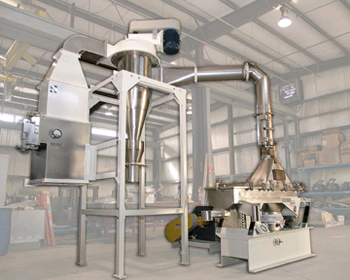
(https://www.witte.com/new-food-grade-process-equipment-integrates-drying-classifying-and-fines-collection-in-a-single-sanitary-sound-attenuated-pilot-sized-unit/)
- Most structural materials are made of stainless steel. Hygienic design that meets USDA, FDA, and 3-A standards*2.
- Tool-free disassembly enables easy cleaning and inspection across drying, cooling, and classification sections—supporting efficient maintenance and contamination prevention.
*1 from official Website (https://www.v-dryer.jp/dryingtest.html)
*2 Related to contact with food and dairy products.