Fluid Bed Dryer Price Guide: Understanding Investment Costs vs. Long-Term ROI
The price of fluid bed dryers varies significantly depending on the model and specifications. This article outlines the reasons for price differences, the risks behind low prices, and the design specifications of high-quality equipment.
The Relationship Between Low-Quality Risks and Cost
If the only goal is to dry the material, even inexpensive machines may be sufficient. However, in industries where maintaining product composition and preventing trace-level contamination are critical, dryer precision directly affects quality. Investing in dryers that prevent foreign matter contamination and ensure uniform drying can be considered one form of risk mitigation.
High-Precision Drying for Stable Production
High-quality fluid bed dryers adjust temperature and airflow to prevent hot spots and thermal degradation. They also prevent quality variations by fluidizing materials through vibration. By preventing defects, they help reduce material waste and improve yield.
Contamination Risk in Low-Cost Equipment
Designs that prioritize low cost may have insufficient weld seams and internal design features. Contamination can occur when material remains in these areas. If the issue escalates to a product recall, the resulting losses could far exceed the difference in equipment price.
Design Specifications to Minimize Downtime
Sealing Performance and Air Intake Systems
Inexpensive equipment often has poor sealing around the air intake filter, creating a risk of foreign matter entering the system. High-quality equipment for semiconductors and pharmaceuticals can maintain high sealing performance through shaft-seal-free designs and air seal structures.
Control Technology That Protects Particle Structure
High-quality equipment with adjustable vibration and airflow prevents intense collisions between materials and helps reduce breakage and wear. It can also help prevent filter clogging caused by fine powder generation.
Why Investing in High-Value-Added Technology Makes Sense
A Fully Sanitary Vibrating Fluid Bed
A vibrating fluid bed dryer is designed to bring the amount of material remaining in the machine close to zero by preventing material retention through vibration. Although the initial investment tends to be higher, it can be considered a necessary investment for balancing quality and sanitation.
Integration of Indirect Heating and Sealed Circulation
A sealed circulation system, or closed system, isolates the process from outside air to enable solvent recovery and help prevent oxidation, but it typically requires larger equipment to maintain a high gas volume. By combining it with indirect heating, gas volume can be reduced, enabling a more compact design. Both quality and space savings can be achieved at the same time.
Why Quality Fluid Bed Dryers Cost More
Differences in specifications are reflected in price differences. If quality is a priority, check whether the following specifications are included.
- Whether vibration and airflow can be adjusted to avoid damaging material properties
- Whether surface treatment is applied for corrosion resistance and cleanability, such as buff polishing or Teflon coating
- Whether automatic cleaning is possible and whether the equipment has a sanitary design that allows easy cleaning for maintainability
Summary
The price of a fluid bed dryer varies significantly depending on whether it includes specifications such as temperature and airflow control, sealed construction, and sanitary design. Choosing based solely on low initial cost carries the risk of higher overall costs due to defects or downtime. In industries where quality is a priority, it is important to pay close attention to dryer performance.
Electronics Manufacturing
- Barium titanate
- Silicon carbide
- Alumina
(VH Type)CHUO KAKOHKI (JPN)

(https://www.chuokakohki.co.jp/dryer.html)
- Ideal for Purity-critical materials like SiC. Sliding-part-free design prevents contamination, while vacuum drying protects against thermal degradation.
- Precision developed through more than 200 drying tests each year*1 delivers uniform drying while preserving material properties, contributing to high-quality semiconductor production and improved productivity.
Fuel Production
- Coal
- Aggregates and industrial sand
- Wood chips

(https://carriervibrating.com/equipment/dryers/)
- Unique electronic control automatically adjusts to different drying times based on the type and condition of minerals and sand.
- Vibration intensity and feed speed adjust according to moisture content and viscosity, helping reduce variation in moisture content.
Food Manufacturing
- Granulated food powders
- Active pharmaceutical ingredients
- Plant-based protein
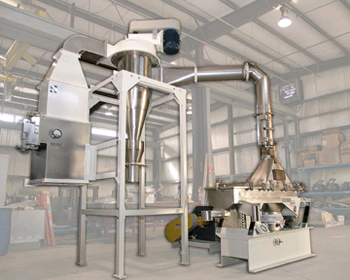
(https://www.witte.com/new-food-grade-process-equipment-integrates-drying-classifying-and-fines-collection-in-a-single-sanitary-sound-attenuated-pilot-sized-unit/)
- Most structural materials are made of stainless steel. Hygienic design that meets USDA, FDA, and 3-A standards*2.
- Tool-free disassembly enables easy cleaning and inspection across drying, cooling, and classification sections—supporting efficient maintenance and contamination prevention.
*1 from official Website (https://www.v-dryer.jp/dryingtest.html)
*2 Related to contact with food and dairy products.