Fluid Bed Dryer Critical Parameters
This article identifies the process parameters that determine fluid bed drying outcomes, why each one matters, and additional parameters vibrating fluid bed dryers introduce.
What Makes a Parameter "Critical"
A critical process parameter is a parameter that has a direct, measurable effect on the finished product's quality and therefore should be monitored or controlled. Plenty of settings can drift slightly without changing the outcome; a critical parameter is one where a small drift shows up as a real defect — uneven moisture, degraded materials, or a batch that falls out of spec.
Inlet Air Temperature
Inlet air temperature sets how fast moisture evaporates and how much thermal stress materials experience. Too low, and the batch won't reach its target moisture content in a reasonable time. Too high, and heat-sensitive materials can degrade, discolor, or lose potency before the batch is even finished. The acceptable range narrows considerably for materials with low heat tolerances, which is part of why the same dryer can be a poor fit for one material and a strong fit for another.
Airflow Rate and Fluidization Velocity
Airflow has to stay above the minimum fluidization velocity for the batch to fluidize at all, but pushing it too far past that point creates its own problems: excessive velocity increases particle-to-particle collisions, generating fines and wearing down fragile material (see our article on the working principle for how this velocity threshold works). Getting this range right, and keeping it stable through the batch, is one of the more difficult parameters to hold constant as material moisture content changes during drying.
Product Temperature and Moisture Endpoint
The parameter that ultimately defines a good batch is the materials' final moisture content, but it's rarely measured directly in real time. Most operators track product or exhaust air temperature as a proxy, since both shift predictably as the material approaches dryness (as covered in our article on the drying process). Treating the proxy measurement as precisely as the moisture target itself is what keeps batches from finishing too wet or unnecessarily overdried.
Vibration Amplitude and Frequency
Vibrating fluid bed dryers add two additional parameters — vibration amplitude and frequency — that standard fluid bed dryers do not have.
Too little vibration fails to assist fluidization for cohesive or sticky materials, defeating the purpose of adding it. Too much vibration can increase particle attrition in fragile materials, the same problem excessive airflow causes. Because the right amplitude and frequency depend heavily on particle size, density, and fragility, these parameters typically need to be tuned per material rather than set once and left alone.
Why Real-Time Monitoring Matters More Than Fixed Setpoints
Raw materials rarely arrive perfectly consistent from batch to batch, so parameters set correctly for one lot can drift out of range for the next without any change to equipment itself. Dryers with sensors that track temperature, airflow, and vibration continuously, and allow adjustment mid-batch, catch this drift before it produces an out-of-spec batch rather than after.
Electronics Manufacturing
- Barium titanate
- Silicon carbide
- Alumina
(VH Type)CHUO KAKOHKI (JPN)

(https://www.chuokakohki.co.jp/dryer.html)
- Ideal for Purity-critical materials like SiC. Sliding-part-free design prevents contamination, while vacuum drying protects against thermal degradation.
- Precision developed through more than 200 drying tests each year*1 delivers uniform drying while preserving material properties, contributing to high-quality semiconductor production and improved productivity.
Fuel Production
- Coal
- Aggregates and industrial sand
- Wood chips

(https://carriervibrating.com/equipment/dryers/)
- Unique electronic control automatically adjusts to different drying times based on the type and condition of minerals and sand.
- Vibration intensity and feed speed adjust according to moisture content and viscosity, helping reduce variation in moisture content.
Food Manufacturing
- Granulated food powders
- Active pharmaceutical ingredients
- Plant-based protein
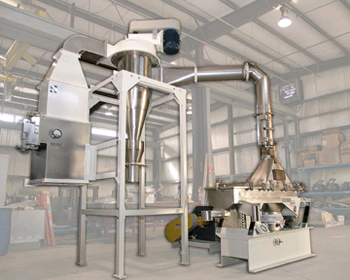
(https://www.witte.com/new-food-grade-process-equipment-integrates-drying-classifying-and-fines-collection-in-a-single-sanitary-sound-attenuated-pilot-sized-unit/)
- Most structural materials are made of stainless steel. Hygienic design that meets USDA, FDA, and 3-A standards*2.
- Tool-free disassembly enables easy cleaning and inspection across drying, cooling, and classification sections—supporting efficient maintenance and contamination prevention.
*1 from official Website (https://www.v-dryer.jp/dryingtest.html)
*2 Related to contact with food and dairy products.