Vacuum Fluid Bed Drying
This article explains why vacuum changes the conditions inside a fluid bed dryer, why standard airflow-driven fluidization breaks down at low pressure, and why vibration takes over as the fluidizing mechanism in a vacuum fluid bed dryer.
Why Vacuum Changes the Drying Conditions, Not Just the Pressure
Lowering the pressure inside a dryer lowers the boiling point of water and solvents, so moisture evaporates at a much lower temperature than it would at atmospheric pressure. That single change protects heat-sensitive materials from thermal degradation and reduces the oxygen available to react with the material during drying, which matters for materials prone to oxidation.
Why Standard Airflow Fluidization Breaks Down Under Vacuum
Fluidization normally depends on the drag force from airflow overcoming gravity and interparticle forces, and that drag force depends on gas density as well as velocity. Under vacuum, gas density drops sharply, so there simply isn't enough gas mass moving through the bed to generate the drag force needed to suspend particles, no matter how high the velocity is pushed.
Why Vibration Becomes the Primary Fluidizing Mechanism
Because airflow can't reliably do the job under vacuum, vibration takes over as the main force keeping particles in motion, rather than acting as a supplement to airflow the way it does at atmospheric pressure. This is why a "vacuum fluid bed dryer" in practice is almost always a vibrating vacuum dryer: vacuum sets the drying atmosphere, while vibration handles the actual particle motion that airflow can no longer provide.
What Vacuum Drying Is Actually Good For
Vacuum operation fits materials that degrade, discolor, or lose activity at the temperatures atmospheric drying would require, and materials where oxidation during drying is a quality risk rather than a cosmetic one. It's also the practical choice when a process needs to recover solvent rather than vent it, since a sealed vacuum system can capture and condense solvent vapor instead of releasing it with exhaust air.
What to Confirm Before Choosing Vacuum Operation
Vacuum drying typically takes longer per batch than airflow-driven drying, since removing the convective heat that hot air would normally provide means heat has to reach the material some other way, usually through a heated jacket or internal heating panels rather than the air itself. Confirming that the equipment can supply enough heat through direct contact, not just enough vacuum, is what determines whether the process actually dries the batch in a reasonable time.
Vacuum Solves the Atmosphere, Vibration Solves the Motion
Vacuum fluid bed drying lowers the temperature and oxygen exposure a material sees during drying, but it removes airflow's ability to fluidize the bed in the process. Vibration fills that gap, which is why vacuum and vibration are paired rather than treated as separate options for materials that need both a controlled atmosphere and reliable particle motion.
The following article introduces recommended vibrating dryers by industry.
Electronics Manufacturing
- Barium titanate
- Silicon carbide
- Alumina
(VH Type)CHUO KAKOHKI (JPN)

(https://www.chuokakohki.co.jp/dryer.html)
- Ideal for Purity-critical materials like SiC. Sliding-part-free design prevents contamination, while vacuum drying protects against thermal degradation.
- Precision developed through more than 200 drying tests each year*1 delivers uniform drying while preserving material properties, contributing to high-quality semiconductor production and improved productivity.
Fuel Production
- Coal
- Aggregates and industrial sand
- Wood chips

(https://carriervibrating.com/equipment/dryers/)
- Unique electronic control automatically adjusts to different drying times based on the type and condition of minerals and sand.
- Vibration intensity and feed speed adjust according to moisture content and viscosity, helping reduce variation in moisture content.
Food Manufacturing
- Granulated food powders
- Active pharmaceutical ingredients
- Plant-based protein
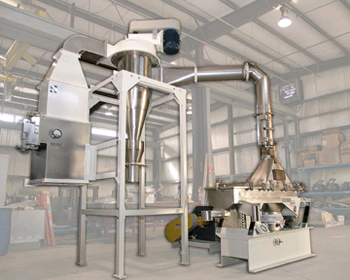
(https://www.witte.com/new-food-grade-process-equipment-integrates-drying-classifying-and-fines-collection-in-a-single-sanitary-sound-attenuated-pilot-sized-unit/)
- Most structural materials are made of stainless steel. Hygienic design that meets USDA, FDA, and 3-A standards*2.
- Tool-free disassembly enables easy cleaning and inspection across drying, cooling, and classification sections—supporting efficient maintenance and contamination prevention.
*1 from official Website (https://www.v-dryer.jp/dryingtest.html)
*2 Related to contact with food and dairy products.