Nanoparticle Agglomeration in Fluid Bed Drying
This article explains why nanoparticles behave differently from the particles a standard fluid bed dryer is designed around, what happens when they agglomerate instead of fluidizing evenly, and how vibration helps prevent it.
Why Nanoparticles Don't Follow the Same Fluidization Rules
The fluidization principle assumes drag force has to overcome gravity and interparticle cohesion, and for most powders, gravity is the larger of the two. As particle size shrinks into the nanometer range, that balance flips: cohesive forces between particles barely change, but the gravitational pull on each particle drops off sharply, so cohesion ends up dominating instead.
What Happens When Nanoparticles Agglomerate Instead of Fluidizing
Instead of separating into individual suspended particles, cohesive nanoparticles stick together into clumps that behave like much larger particles. Airflow that would easily fluidize the true particle size often isn't enough to fluidize these clumps, so parts of the bed stay static while air channels around them rather than through them.
Why This Matters Beyond Just Getting the Material to Move
A clump doesn't dry the way a single particle does: moisture at its core is shielded from airflow by the particles around it, so a batch can look and test dry at the surface while still holding moisture inside the agglomerates. Breaking up clumps after drying to get back to the original particle size adds a processing step that a clean, non-agglomerated dry would have avoided entirely.
How Vibration Helps Break Up and Prevent Agglomerates
Mechanical vibration adds energy directly to the particles rather than relying on airflow to overcome cohesion indirectly. That extra energy is often enough to break newly formed clumps apart before they grow, and to keep individual particles separated as they dry rather than letting them re-agglomerate as moisture leaves.
What to Confirm When Drying Nanomaterials
Agglomeration tendency isn't just a function of particle size: surface chemistry, residual moisture, and electrostatic charge all affect how strongly particles stick together, and two materials with the same nominal particle size can behave very differently. Testing fluidization behavior with the actual material, rather than assuming it will match a similar-looking reference case, is what actually predicts whether a batch will fluidize cleanly or clump.
Why Nanoparticle Drying Is a Cohesion Problem, Not Just a Size Problem
Nanoparticles resist standard fluidization because cohesive forces dominate over gravity at that scale, not because they're simply too small for airflow to lift. Vibration addresses that cohesion directly, which is why it plays a larger role in nanoparticle drying than in drying most conventional powders.
The following article introduces recommended vibrating dryers by industry.
Electronics Manufacturing
- Barium titanate
- Silicon carbide
- Alumina
(VH Type)CHUO KAKOHKI (JPN)

(https://www.chuokakohki.co.jp/dryer.html)
- Ideal for Purity-critical materials like SiC. Sliding-part-free design prevents contamination, while vacuum drying protects against thermal degradation.
- Precision developed through more than 200 drying tests each year*1 delivers uniform drying while preserving material properties, contributing to high-quality semiconductor production and improved productivity.
Fuel Production
- Coal
- Aggregates and industrial sand
- Wood chips

(https://carriervibrating.com/equipment/dryers/)
- Unique electronic control automatically adjusts to different drying times based on the type and condition of minerals and sand.
- Vibration intensity and feed speed adjust according to moisture content and viscosity, helping reduce variation in moisture content.
Food Manufacturing
- Granulated food powders
- Active pharmaceutical ingredients
- Plant-based protein
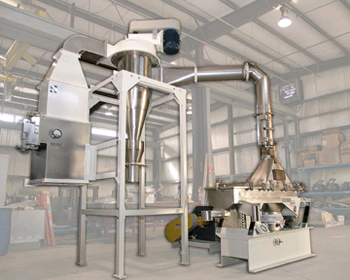
(https://www.witte.com/new-food-grade-process-equipment-integrates-drying-classifying-and-fines-collection-in-a-single-sanitary-sound-attenuated-pilot-sized-unit/)
- Most structural materials are made of stainless steel. Hygienic design that meets USDA, FDA, and 3-A standards*2.
- Tool-free disassembly enables easy cleaning and inspection across drying, cooling, and classification sections—supporting efficient maintenance and contamination prevention.
*1 from official Website (https://www.v-dryer.jp/dryingtest.html)
*2 Related to contact with food and dairy products.