Fluid Bed Dryer Mechanism
This article breaks down the core components of fluid bed dryers and how they work together to create and control fluidization. It also covers the additional components that vibrating fluid bed dryers add versus standard air-only mechanisms.
The Core Components of a Fluid Bed Dryer
Fluid bed dryers consist of a small set of parts working in sequence: a plenum chamber that receives incoming air, a distributor plate that spreads that air evenly across the base of the bed, a drying chamber where materials fluidize, and an exhaust system that carries spent air and fine particles out of units.
Each part has one job, and a weakness in any single component shows up as a fluidization problem somewhere else in units.
The Air Handling System That Drives Fluidization
A blower pulls in air and pushes it through a heater before it enters the plenum chamber beneath the bed. Inlet filters clean this air before it reaches the materials, since dust or debris in the incoming air becomes a contamination source once it mixes with products.
The blower and heater together determine both the volume and temperature of air available to fluidize and dry materials, which is why undersized or poorly matched air handling components are a common cause of underperforming units.
Distributor Plate Design and Its Effect on Performance
The distributor plate sits between the plenum and the bed, and its hole pattern controls how evenly air spreads across the base. A plate with uneven hole spacing or the wrong open-area ratio creates dead zones where materials barely move, alongside areas where air rushes through unrestricted.
Plate material and hole geometry also affect how easily units can be cleaned between batches, since narrow holes and sharp edges trap fine powder that plain sweeping won't remove.
Exhaust and Dust Collection Components
Air leaving the drying chamber carries fine particles with it, so most units route exhaust through a cyclone, a bag filter, or both before releasing it. The cyclone removes larger fine particles by spinning them out of the airstream, while the bag filter captures what the cyclone misses.
The size and type of this filtration hardware set the practical limit on how much fine powder units can generate before yield losses or filter changeouts start affecting output.
How Vibrating Fluid Bed Dryers Add to This Mechanism
Vibrating fluid bed dryers add vibration drives, typically a motor connected to eccentric weights, mounted beneath a deck that rests on springs. Instead of relying on the air handling system alone to keep every particle suspended, the vibrating deck imparts mechanical motion directly into the bed.
Some designs add heating panels or a jacketed wall to the drying chamber itself, supplying heat by direct contact in addition to, or instead of, hot air. Combined with the vibrating deck, this lets units dry materials that a standard air-only mechanism would struggle to move.
Why Mechanism Details Matter When Comparing Equipment
Two dryers with similar specifications on paper can perform very differently depending on distributor plate design, filtration capacity, and how the vibration drive is integrated into the frame. Reviewing these mechanical details, not just headline capacity or price, is what separates units that hold up under daily production from those that need constant adjustment.
Electronics Manufacturing
- Barium titanate
- Silicon carbide
- Alumina
(VH Type)CHUO KAKOHKI (JPN)

(https://www.chuokakohki.co.jp/dryer.html)
- Ideal for Purity-critical materials like SiC. Sliding-part-free design prevents contamination, while vacuum drying protects against thermal degradation.
- Precision developed through more than 200 drying tests each year*1 delivers uniform drying while preserving material properties, contributing to high-quality semiconductor production and improved productivity.
Fuel Production
- Coal
- Aggregates and industrial sand
- Wood chips

(https://carriervibrating.com/equipment/dryers/)
- Unique electronic control automatically adjusts to different drying times based on the type and condition of minerals and sand.
- Vibration intensity and feed speed adjust according to moisture content and viscosity, helping reduce variation in moisture content.
Food Manufacturing
- Granulated food powders
- Active pharmaceutical ingredients
- Plant-based protein
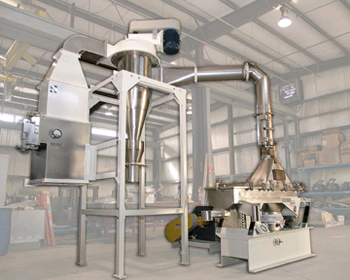
(https://www.witte.com/new-food-grade-process-equipment-integrates-drying-classifying-and-fines-collection-in-a-single-sanitary-sound-attenuated-pilot-sized-unit/)
- Most structural materials are made of stainless steel. Hygienic design that meets USDA, FDA, and 3-A standards*2.
- Tool-free disassembly enables easy cleaning and inspection across drying, cooling, and classification sections—supporting efficient maintenance and contamination prevention.
*1 from official Website (https://www.v-dryer.jp/dryingtest.html)
*2 Related to contact with food and dairy products.