Fluid Bed Dryer Working Principle
This article explains the physical principle behind fluid bed drying: how fluidization happens, and why it drives efficient heat and moisture transfers. It also covers how vibration extends this principle to materials that air alone cannot fluidize.
The Physical Principle Behind Fluidization
Fluidization begins when the drag force from upward airflow through a bed of particles matches or exceeds the combined pull of gravity and the forces holding particles together. Below that threshold, called the minimum fluidization velocity, the bed stays packed and behaves like a solid. Once airflow crosses it, particles separate from one another and start moving as a suspended mass, similar to a boiling liquid.
This threshold is not a fixed number. It shifts with particle size, density, and how strongly particles cling to each other, which is why the same airflow setting fluidizes some materials and leaves others sitting flat.
Why This Principle Makes Drying So Efficient
Once particles are suspended, hot air reaches the entire surface of every particle at nearly the same moment. Heat and moisture move in and out of each particle almost simultaneously, instead of spreading slowly from the outer layer inward as it happens in a static bed.
This is why fluid bed dryers dry faster and more evenly than static drying methods at a comparable size: the physical mechanism, not the equipment size, sets the ceiling on how fast and how evenly a batch can dry.
Where the Basic Principle Breaks Down
Sticky, cohesive, and high-moisture materials often resist fluidization even when the calculated airflow should be enough. Instead of separating into a suspended mass, particles clump together and drag on each other, so parts of the bed never reach the minimum fluidization velocity at all.
A wide particle-size distribution creates a related problem. Larger particles need more airflow to lift than smaller ones, so the velocity that fluidizes the coarse fraction can blow the fine fraction straight out of the bed before it finishes drying.
How Vibration Changes the Underlying Principle
Vibration adds a second force input alongside airflow. Instead of relying on air alone to overcome gravity and interparticle cohesion, mechanical vibration helps break up clumps and keeps particles in motion even when airflow on its own would fall short of the minimum fluidization velocity.
This changes what the equipment can process, not just how it operates. Materials that would channel or sit static under a conventional fluid bed can still fluidize, because vibration is doing part of the work that air would otherwise have to do alone.
Because less air is needed to keep the bed moving, less hot air is needed to supply heat as well. That opens the door to indirect heating through a heated vessel wall or jacket, which can deliver much of the required heat without pushing air volume any higher.
Why Understanding This Principle Matters for Equipment Selection
A dryer rated for one kind of material won't necessarily perform the same way on another, because the same fluidization principle plays out differently depending on particle size, moisture content, and cohesiveness. Catalog figures describe typical conditions, not the materials' actual behaviors under airflow. Confirming how specific materials fluidize, rather than assuming they will behave like a reference case on a spec sheet, is what actually determines whether a given design will dry them consistently.
Electronics Manufacturing
- Barium titanate
- Silicon carbide
- Alumina
(VH Type)CHUO KAKOHKI (JPN)

(https://www.chuokakohki.co.jp/dryer.html)
- Ideal for Purity-critical materials like SiC. Sliding-part-free design prevents contamination, while vacuum drying protects against thermal degradation.
- Precision developed through more than 200 drying tests each year*1 delivers uniform drying while preserving material properties, contributing to high-quality semiconductor production and improved productivity.
Fuel Production
- Coal
- Aggregates and industrial sand
- Wood chips

(https://carriervibrating.com/equipment/dryers/)
- Unique electronic control automatically adjusts to different drying times based on the type and condition of minerals and sand.
- Vibration intensity and feed speed adjust according to moisture content and viscosity, helping reduce variation in moisture content.
Food Manufacturing
- Granulated food powders
- Active pharmaceutical ingredients
- Plant-based protein
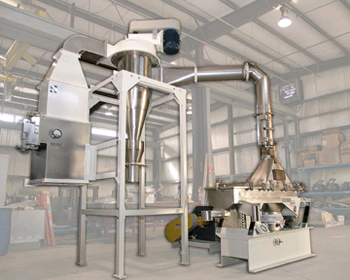
(https://www.witte.com/new-food-grade-process-equipment-integrates-drying-classifying-and-fines-collection-in-a-single-sanitary-sound-attenuated-pilot-sized-unit/)
- Most structural materials are made of stainless steel. Hygienic design that meets USDA, FDA, and 3-A standards*2.
- Tool-free disassembly enables easy cleaning and inspection across drying, cooling, and classification sections—supporting efficient maintenance and contamination prevention.
*1 from official Website (https://www.v-dryer.jp/dryingtest.html)
*2 Related to contact with food and dairy products.