Cleaning Validation for Fluid Bed Dryers
This article explains what cleaning validation actually proves for a fluid bed dryer, how residue is measured to demonstrate it, and why the equipment's internal design does as much to determine success as the cleaning method itself.
What Cleaning Validation Actually Proves
Cleaning validation confirms that a defined cleaning process consistently brings residue from the previous product, and any cleaning agent used, below a calculated acceptable limit — not that the equipment simply looks clean. That limit is typically based on the most potent or most toxic product likely to run through the equipment, so the standard the cleaning has to meet depends on what else shares the dryer, not just on the product being cleaned up after.
How Residue Is Actually Measured
Direct surface sampling, usually by swabbing defined locations, works for areas an operator can physically reach. Rinse sampling covers areas that can't be swabbed, such as the inside of ductwork or filter housings, by analyzing the final rinse water instead of the surface itself. Both methods rely on an analytical test, often total organic carbon or a product-specific assay, because a surface that looks clean can still carry residue below what the eye can detect.
Why Fluid Bed Dryers Are Particularly Hard to Validate
A distributor plate's holes, the pleats inside a bag filter, and the gaps around a poorly sealed access panel are exactly the kind of locations that are difficult to swab directly and easy to miss during a validation study. Each of these becomes a "worst case" location that has to be justified and tested, and the more of them a design has, the more sampling points a validation protocol needs to cover.
Why Manual Cleaning Makes Validation Harder Than CIP Does
A manual cleaning process depends on how thoroughly a specific operator scrubs a specific area, which means validation has to account for the worst realistic technique, not just the best one. An automated clean-in-place cycle runs the same spray pattern, flow rate, and duration every time, so once that fixed cycle is validated, it can be relied on consistently instead of being re-justified against operator variability.
Design Features That Make Cleaning Validation Easier to Pass
Fewer internal components mean fewer worst-case locations to sample and justify in the first place. A dryer without an internal shaft or seal removes an entire category of hard-to-reach crevices from the validation study, and smooth internal surfaces without dead legs reduce the number of spots where residue can realistically hide from a rinse or swab.
Cleaning Validation Is as Much About Design as It Is About Method
Cleaning validation proves that residue stays below an acceptable limit, not that equipment looks clean, and proving it gets harder as a dryer's internal geometry adds more hard-to-reach locations to test. A simpler internal design and a repeatable CIP cycle both reduce the number of things a validation study has to justify.
The following article introduces recommended vibrating dryers by industry.
Electronics Manufacturing
- Barium titanate
- Silicon carbide
- Alumina
(VH Type)CHUO KAKOHKI (JPN)

(https://www.chuokakohki.co.jp/dryer.html)
- Ideal for Purity-critical materials like SiC. Sliding-part-free design prevents contamination, while vacuum drying protects against thermal degradation.
- Precision developed through more than 200 drying tests each year*1 delivers uniform drying while preserving material properties, contributing to high-quality semiconductor production and improved productivity.
Fuel Production
- Coal
- Aggregates and industrial sand
- Wood chips

(https://carriervibrating.com/equipment/dryers/)
- Unique electronic control automatically adjusts to different drying times based on the type and condition of minerals and sand.
- Vibration intensity and feed speed adjust according to moisture content and viscosity, helping reduce variation in moisture content.
Food Manufacturing
- Granulated food powders
- Active pharmaceutical ingredients
- Plant-based protein
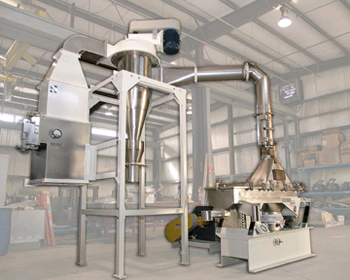
(https://www.witte.com/new-food-grade-process-equipment-integrates-drying-classifying-and-fines-collection-in-a-single-sanitary-sound-attenuated-pilot-sized-unit/)
- Most structural materials are made of stainless steel. Hygienic design that meets USDA, FDA, and 3-A standards*2.
- Tool-free disassembly enables easy cleaning and inspection across drying, cooling, and classification sections—supporting efficient maintenance and contamination prevention.
*1 from official Website (https://www.v-dryer.jp/dryingtest.html)
*2 Related to contact with food and dairy products.