SOP for Fluid Bed Dryers
This article explains what a fluid bed dryer SOP (standard operating procedure) actually documents, the sections a well-built one typically includes, and why the document itself matters as much as the steps it describes.
What an SOP Actually Documents
A standard operating procedure exists to make equipment operation independent of who happens to be running it. Rather than relying on one experienced operator's memory of how a batch should go, an SOP writes down the exact sequence, checks, and limits so that any trained operator produces the same result.
This matters more for a fluid bed dryer than it might for simpler equipment, because small deviations in airflow, temperature, or timing can shift a batch outside its target moisture range without anyone realizing it happened.
Core Sections a Fluid Bed Dryer SOP Typically Includes
Most SOPs for this equipment follow a similar structure: a purpose and scope statement, defined responsibilities for who can operate and who signs off, a list of required equipment and materials, a pre-operational check section, the operating procedure itself, a shutdown and cleaning procedure, safety precautions, and a documentation section for recording what actually happened.
The steps themselves are only one part of this. The surrounding sections — responsibility, checks, documentation — are what make the procedure enforceable and auditable, not just descriptive.
Why Pre-Operational Checks Matter Before Every Batch
Before startup, an SOP typically requires confirming that the distributor plate and filters are clean and intact, that setpoints match the values confirmed during qualification, and that safety systems are functioning. Skipping this step doesn't just risk safety — it's one of the most common ways a batch ends up outside spec for reasons that have nothing to do with the equipment's actual capability.
Why Safety Precautions Get Their Own Section
Fluid bed dryers move large volumes of fine powder through hot, fast-moving air, conditions that can generate static charge and combustible dust. SOPs commonly include grounding and bonding checks, confirmation that dust collection and explosion-relief systems are in place, and a clear emergency shutdown procedure, treated as mandatory steps rather than general advice.
Why Documentation Matters as Much as the Procedure Itself
A completed batch record showing what was actually checked, run, and observed is what lets a deviation be traced back to its cause later, rather than leaving it unclear whether a problem came from the material, the equipment, or a step that was skipped. This record-keeping is also what supports the batch-to-batch evidence performance qualification depends on.
What Makes an SOP More Than a Checklist
A fluid bed dryer SOP is more than the steps of a drying cycle: it defines responsibility, sets required checks, addresses combustible dust safety, and creates the records that prove a batch was run correctly. Equipment with sensors and controls that make these checks easier to confirm, rather than harder, is what keeps an SOP practical to follow rather than just filed away.
The following article introduces recommended vibrating dryers by industry.
Electronics Manufacturing
- Barium titanate
- Silicon carbide
- Alumina
(VH Type)CHUO KAKOHKI (JPN)

(https://www.chuokakohki.co.jp/dryer.html)
- Ideal for Purity-critical materials like SiC. Sliding-part-free design prevents contamination, while vacuum drying protects against thermal degradation.
- Precision developed through more than 200 drying tests each year*1 delivers uniform drying while preserving material properties, contributing to high-quality semiconductor production and improved productivity.
Fuel Production
- Coal
- Aggregates and industrial sand
- Wood chips

(https://carriervibrating.com/equipment/dryers/)
- Unique electronic control automatically adjusts to different drying times based on the type and condition of minerals and sand.
- Vibration intensity and feed speed adjust according to moisture content and viscosity, helping reduce variation in moisture content.
Food Manufacturing
- Granulated food powders
- Active pharmaceutical ingredients
- Plant-based protein
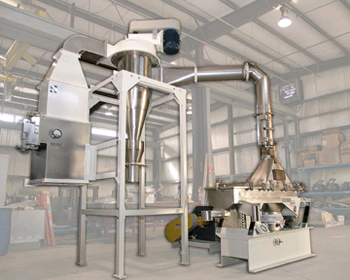
(https://www.witte.com/new-food-grade-process-equipment-integrates-drying-classifying-and-fines-collection-in-a-single-sanitary-sound-attenuated-pilot-sized-unit/)
- Most structural materials are made of stainless steel. Hygienic design that meets USDA, FDA, and 3-A standards*2.
- Tool-free disassembly enables easy cleaning and inspection across drying, cooling, and classification sections—supporting efficient maintenance and contamination prevention.
*1 from official Website (https://www.v-dryer.jp/dryingtest.html)
*2 Related to contact with food and dairy products.